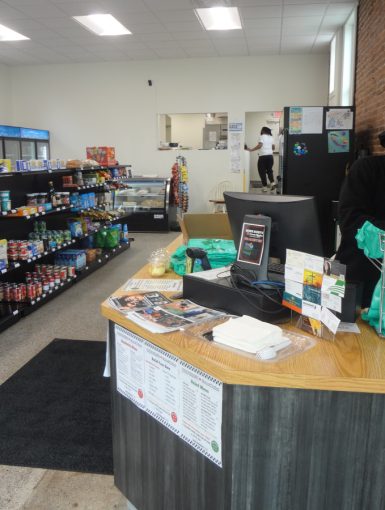
In the early afternoon of Wednesday, Sept. 17, emergency rooms in Charleston, West Virginia, began experiencing an influx of people in the throes of a drug overdose. By the following morning, some three dozen overdoses had been reported, many resulting in hospitalization and intubation. Emergency staff were overwhelmed.
“A lot of the patients were vacillating between extreme agitation and somnolence,” said Ashley Murphy, director of addiction services for Charleston Area Medical Center. “We couldn’t wake them up.”
As word spread that there was something dangerous in the drug supply, SOAR WV, a community group that assists and advocates for people who use drugs, began sending texts and emails to those in its database.
“Please go slow, carry naloxone, and CALL 911,” the messages urged.
That SOAR was able to reach several thousand people with a warning was the result of seven years of relationship-building. The organization was founded in 2018 after the Kanawha-Charleston Health Department shut down its syringe services program under political pressure.

“This moment was the new normal,” Joe Solomon, SOAR’s co-director and a member of the Charleston City Council, said of the recent cluster of overdoses. “Like, ‘Wow, there’s overdoses everywhere. There’s overdoses on every block.’”
Charleston now has a pot of opioid settlement money to spend — $5.2 million of the more than $1 billion the state is receiving. But Solomon is frustrated that as local officials consider how to spend that money, syringe services programs, which he considers an essential tool in saving lives and preventing communicable diseases, continue to be restrained by state and local governments.
Charleston’s old new normal, Soloman said, had been “pretty much kind of a nightmare for a long while,” with Kanawha County at or near the top for fatal overdoses in the state with the highest rate in the country.
Solomon believes that, maybe, the shock of those overdoses could change some minds.
Murphy agrees.
“Syringe services should be part of the continuum of care,” she said. “Something different has to be done.”
Comprehensive Syringe Services
When it launched in 2018, SOAR began hosting health fairs in Kanawha County. There, the group distributed naloxone, provided HIV testing, offered treatment and referrals and gave out clean syringes. The primary attraction of the fairs for many — arguably, most — was the access to uncontaminated syringes. But then, SOAR volunteers took the opportunity to offer the other potentially lifesaving services to participants, and to establish and maintain communication.
Research indicates that people who participate in syringe services programs are more likely than those who don’t to reduce their injection-drug use or stop altogether, and are more likely to enter and remain in treatment. SSPs have also been shown to reduce the spread of HIV and hepatitis C by about 50%.
By 2020, Kanawha County was in the midst of what the Centers for Disease Control and Prevention later determined was “the most concerning” HIV outbreak in the country. After the CDC came to town to investigate in 2021, health officials urged the city to expand access to “sterile syringes and other injection equipment through comprehensive harm reduction services, such as low-barrier, one-stop shop models” — precisely as SOAR had been doing.
Nonetheless, that same year the West Virginia Legislature heightened restrictions on SSPs and introduced fines for violations of those restrictions. The Charleston City Council then set further restrictions and added misdemeanor charges for violations. As a result, SOAR stopped the syringe distribution part of its program.
West Virginia Health Right continues to operate an exchange program in the city under those restrictions, though data from 2024 indicates it exchanged fewer than 20 syringes a day. At each of its biweekly health fairs in late-2020 and early-2021, SOAR was distributing 10,000 or more.
To the immediate north of West Virginia, in Pennsylvania, the political climate is much more conducive to syringe services, at least in Pittsburgh and surrounding Alleghany County. There, Prevention Point Pittsburgh is receiving more than a half-million dollars in opioid settlement money this year, which it can spend on any of the services and supplies it offers, including syringes.
“Overdose fatalities were spiking in 2017 all over Pennsylvania,” said Aaron Arnold, PPP’s executive director. “Fentanyl was starting to dominate the market.” This prompted the state of Pennsylvania “to take a pretty progressive approach.”
When he started working for PPP in 2015, Arnold said it had a staff of three, operating from two locations, exchanging maybe 300,000 syringes a year. There are now five locations and 17 full-time staff members distributing more than 2 million syringes each year.
In addition to offering clean syringes, PPP provides naloxone and supplies for safer smoking, injecting and snorting. It tests for infectious diseases. It has an overdose-prevention program, a wound-care program and a mobile buprenorphine service staffed by providers from local health systems. It offers behavioral health assistance.
PPP also has a team of social workers who help with “things like IDs, social security applications, getting people on medical assistance, housing — all the basic human-needs type of things,” Arnold said.
The region typically experiences only one or two new HIV diagnoses each year in which intravenous drug use is considered the primary cause. With 30 years of syringes exchange, “we really think that we got in before the numbers got high, and have been keeping them low,” Arnold said.
The state of Pennsylvania’s approach to syringe exchange, he said, has been, essentially, that “as long as you have local permission, we have no interest in coming in and changing anything.”
His organization is supported by local health officials.
“For over 30 years, Prevention Point Pittsburgh has met people where they are, delivering harm reduction, screening and treatment services in the neighborhoods that need them most,” said Katie Wooten, the Allegheny County Health Department’s overdose prevention program manager.
Wooten noted that PPP has also received funding from the CDC’s Overdose Data to Action grant, which has expanded their capacity “to save lives and strengthen the community’s response to overdose.”
But getting a larger chunk of money from the state’s opioid settlement funds gives them stability, and a break from having to perpetually piece together grant funding.
“I call it a blessing,” Arnold said, “but it’s really like a miracle.”
One Bite at a Time
Ashley McElwee began using psychoactive substances in college, primarily alcohol and pills.
“It was immediate, the effect I felt,” she said. “I was like, ‘Oh, this is what I’ve been waiting for, what I’ve been looking for my whole life.’”
“What I was really missing was connection to other people,” McElwee said. “I spent most of the decade-plus that I was in active use bouncing around, looking for my home, my community, my people, meaning in life.”
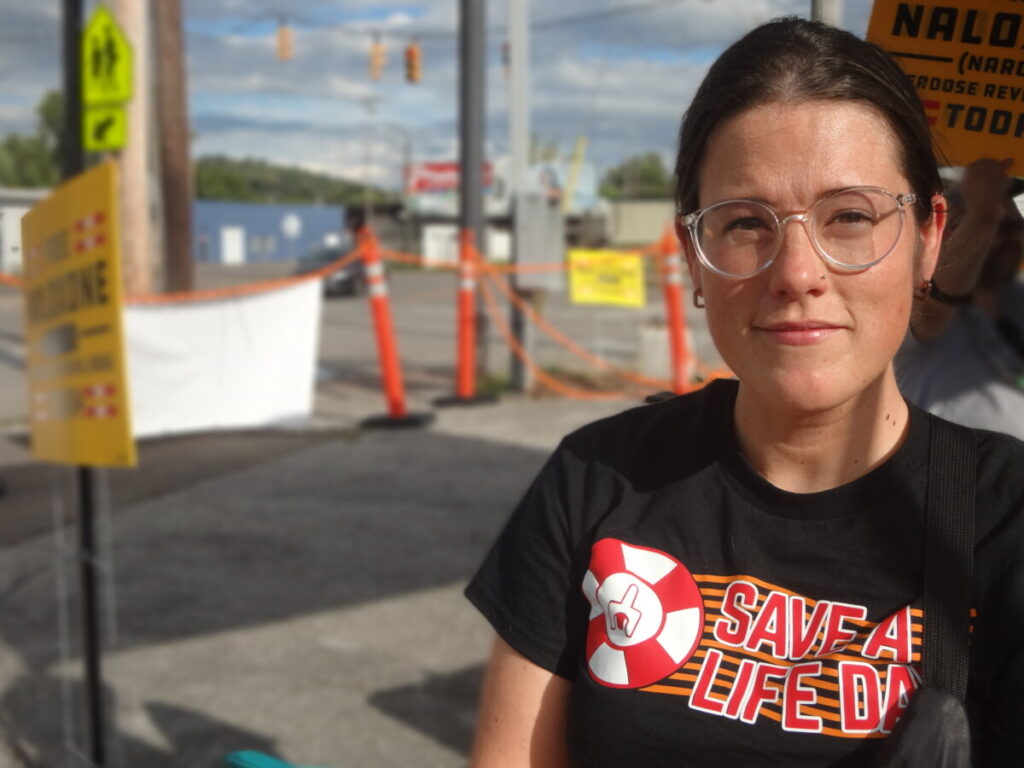
She found recovery and community in Charleston. Now, she’s an advocate — and was selected as a member of the Charleston Opioid Community Council, which is providing guidance on the allocation of settlement funding.
“I’m really hopeful that this is an opportunity for people to have inspired, frank conversations,” McElwee said of the opioid settlement deliberations. “The more we talk about this, the more hopeful I am that we can decide as a community what works and what doesn’t, and work through some of the stigma and miseducation.”
Sarah Stone serves with Solomon as SOAR co-director and is also on the Opioid Community Council with McElwee, who she credits with leading the charge in generating community conversations about how to most effectively invest opioid settlement money. That Mayor Amy Shuler Goodwin appointed two harm reduction advocates to serve on the council was, she said, “a really, really delightful surprise.”
While their region is often cited as the epicenter of the nation’s overdose crisis, advocates here emphasize that they’re also at the forefront of countering it.
In 2020, SOAR staged the inaugural Save a Life Day, distributing free naloxone from locations in Kanawha and Putnam counties. This year, all 50 states participated, with more than 1,000 events. In Kanawha alone, volunteers distributed 7,236 doses of naloxone.
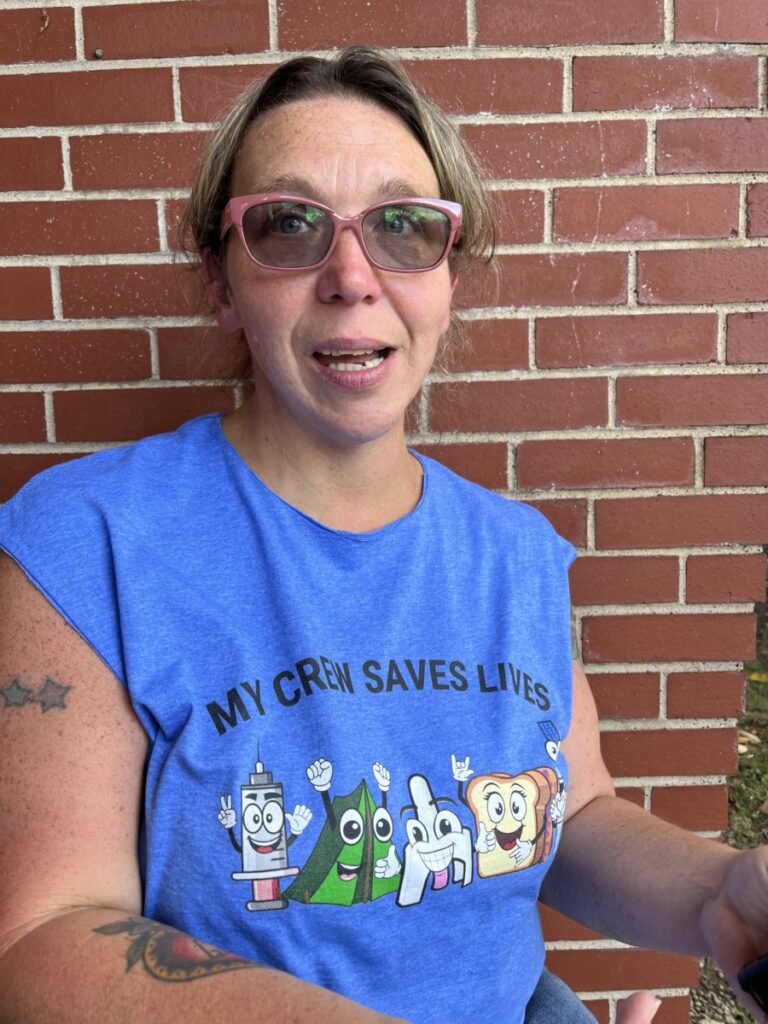
Stone spent much of this year’s Save a Life Day doing outreach in the community – venturing into the “hidden places,” the riverside encampments, under bridges, behind a Kroger grocery store – an experience that both filled her heart and broke it: people so grateful for what they’re given; a reminder of how much more could be done. But she keeps reminding herself of the old adage: “How do you eat an elephant? One bite at a time.”
And locally, she’s seeing small signs of progress. When, in 2021, city council passed the ordinance restricting syringe services, only one councilmember voted against it.
But by August 2023, when the Women’s Health Center of West Virginia submitted a proposal to city council to operate an SSP in the city’s West Side community, and was rejected, nine members dissented from the decision.
Though the rejection was “hurtful, and we take it personally,” Stone said, at least a few minds had apparently been changed in the interim.
“I couldn’t dare say it out loud, because [that decision] was so awful,” she said. “But I was like, ‘There’s another bite of the elephant.’”
Big picture, politically speaking, these are not the best of days for harm reduction in general.
In July, President Donald Trump signed an executive order called “Ending Crime and Disorder on America’s Streets,” which states that discretionary grants issued by the federal Substance Abuse and Mental Health Services Administration should not be spent on “so-called ‘harm reduction’” efforts “that only facilitate illegal drug use and its attendant harm.”
Such language alarms Aaron Arnold.
“The big fear is somebody’s got a bone to pick about harm reduction, and they’re going to pick it sooner or later, and really come after us,” he said. “That’s just our assumption, that at some point we will be fully under scrutiny, they will chip away at our funding, and we will have to go back underground.”
Local advocates acknowledge that a clean syringe wouldn’t have prevented the three dozen overdoses Charleston experienced in those hours in September. But, they argue, a relationship with a syringe services program might have allowed a person to be better informed, perhaps to have been more likely to have naloxone on hand, to know where to turn for help.
For McElwee, making sure the money that’s intended as some small redress for the incalculable harm visited on this region is responsibly spent is personal. She knows what works.
“At its heart,” she said, “harm reduction is a radical expression of love. It’s basically saying, ‘I don’t care where you’re at in life, you are a human being; you deserve dignity, respect, and you are valued. And I think that belief in action is really what brings people back.”
“I think that as human beings, that’s our obligation to each other.”
From now until December 31, every donation made to 100 Days in Appalachia will be doubled by NewsMatch, a yearly fundraising campaign that supports independent, public service journalism, supported by the Institute for Nonprofit News and various U.S. foundations.
If you donate $5, we receive $10; if you donate $100, we will receive $200; and, if you donate $10 monthly, we receive $240. Recurring donations help us most!
If we meet our goal of raising $15,000, we will receive $30,000 to fund reporting for Appalachians, by Appalachians.